Mapping Encryption Standards and Verification Layers in Mobile Gaming Transactions Across Global Regulatory Frameworks
Written by Cameron Richter · Jul 19, 2026
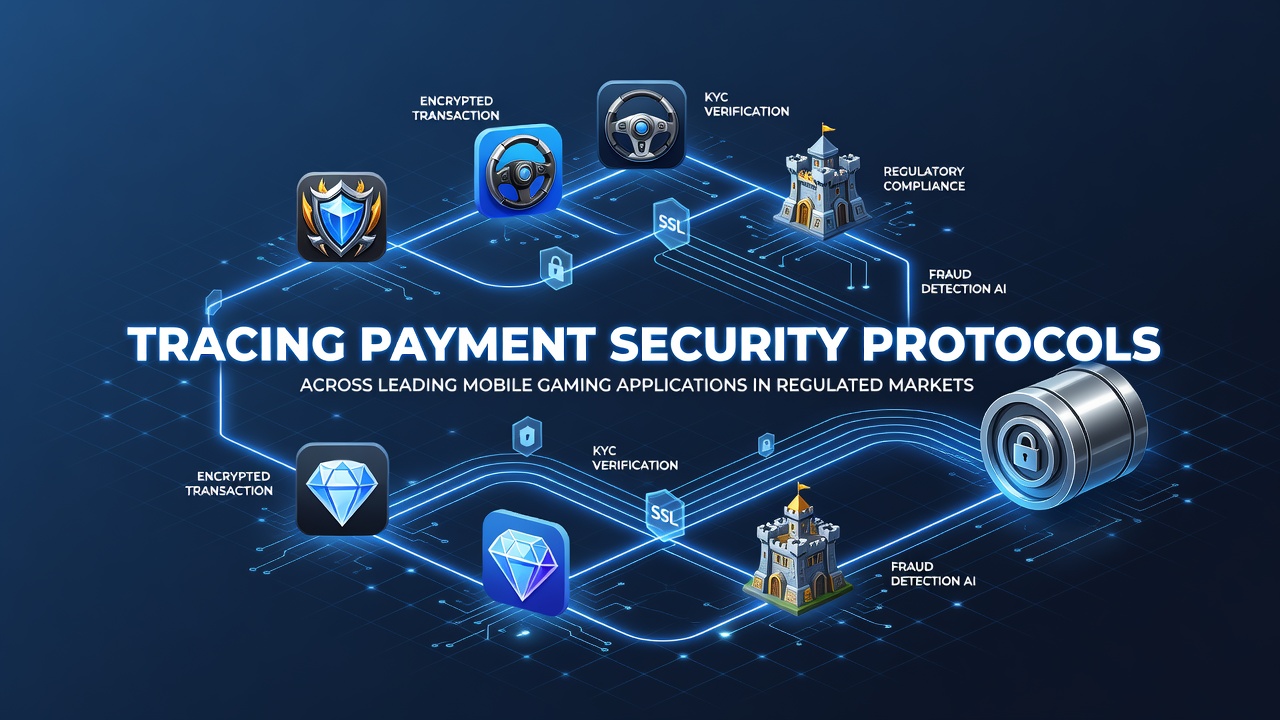
Mapping Encryption Standards and Verification Layers in Mobile Gaming Transactions Across Global Regulatory Frameworks
Payment security protocols in mobile gaming applications have evolved through layered encryption methods, tokenization systems, and multi-factor verification processes that align with requirements from various international oversight bodies. Regulated markets in North America, Europe, and the Asia-Pacific region enforce distinct compliance benchmarks that shape how leading applications handle transaction data, and these frameworks continue to adapt as of July 2026.
Core Technical Components in Regulated Environments
Leading mobile gaming platforms integrate Transport Layer Security protocols alongside end-to-end encryption to protect user financial details during deposits and withdrawals. Tokenization replaces sensitive card information with unique identifiers that cannot be reversed without access to secure vaults maintained by payment processors, and this approach meets standards set by the Payment Card Industry Security Standards Council across multiple jurisdictions. Observers note that applications licensed in Nevada and New Jersey incorporate device fingerprinting combined with behavioral analytics to flag unusual activity before transactions complete.
Regulators in the European Union require adherence to the Revised Directive on Payment Services, which mandates strong customer authentication for electronic transfers. Applications operating under Malta Gaming Authority licenses apply these rules through real-time risk scoring engines that evaluate transaction velocity and geographic signals, while similar systems appear in platforms licensed by the Alcohol and Gaming Commission of Ontario in Canada.
Regional Variations in Implementation
Markets in Australia enforce data localization rules that require certain transaction records to remain on domestic servers, and this influences how gaming applications structure their payment gateways. Research from the University of Melbourne indicates that localized storage reduces latency in fraud detection models without compromising overall security posture. In contrast, several Asian regulatory frameworks emphasize partnerships with regional banks that provide direct API connections for instant verification, bypassing traditional card networks in some cases.
Applications targeting the United States market navigate a patchwork of state-level rules, where each jurisdiction maintains its own audit requirements for payment logs. Those who've studied compliance reports observe that platforms active in multiple states maintain separate encryption key management systems to satisfy differing retention periods, and this modular design allows for rapid updates when individual states revise their technical specifications.
Verification and Monitoring Practices
Multi-factor authentication extends beyond passwords to include biometric checks and one-time codes delivered through dedicated applications. Data from industry reports compiled by the European Gaming and Betting Association shows that platforms using these layered checks experience measurable reductions in unauthorized access attempts compared with single-method systems. Continuous monitoring tools scan for anomalies such as rapid successive transactions or mismatched device locations, triggering temporary holds that require manual review by security teams.
Third-party auditors conduct regular penetration tests and code reviews to identify potential weaknesses before they can be exploited. These assessments often cover the full payment flow from in-app purchase initiation through settlement, and findings feed directly into iterative improvements of the underlying protocols.
Emerging Developments and Cross-Border Coordination
Quantum-resistant encryption algorithms are entering early testing phases within several regulated markets, driven by concerns that future computing advances could compromise current public-key systems. Collaborative working groups involving regulators from multiple countries share threat intelligence on emerging attack vectors, allowing applications to update their defenses in coordinated fashion. Payment processors have begun rolling out support for decentralized ledger technologies in pilot programs, though widespread adoption remains limited to specific corridors where regulatory approval has been granted.
Applications that operate across borders maintain compliance matrices that map each market's unique requirements onto unified technical controls, and this mapping process becomes increasingly complex as new rules emerge. Those tracking these developments note that the emphasis on interoperability between different national standards is growing, particularly for operators seeking to expand into additional licensed territories without rebuilding entire payment infrastructures.
Conclusion
Tracing payment security protocols across leading mobile gaming applications reveals a landscape defined by overlapping technical standards, regional mandates, and ongoing adaptation to new threats. Regulated markets continue to refine their expectations around encryption, authentication, and monitoring, while applications respond through modular architectures that accommodate these shifts efficiently. The interplay between these elements shapes how transactions are protected in practice, and the patterns established through July 2026 suggest continued convergence around core principles even as implementation details vary by jurisdiction.